


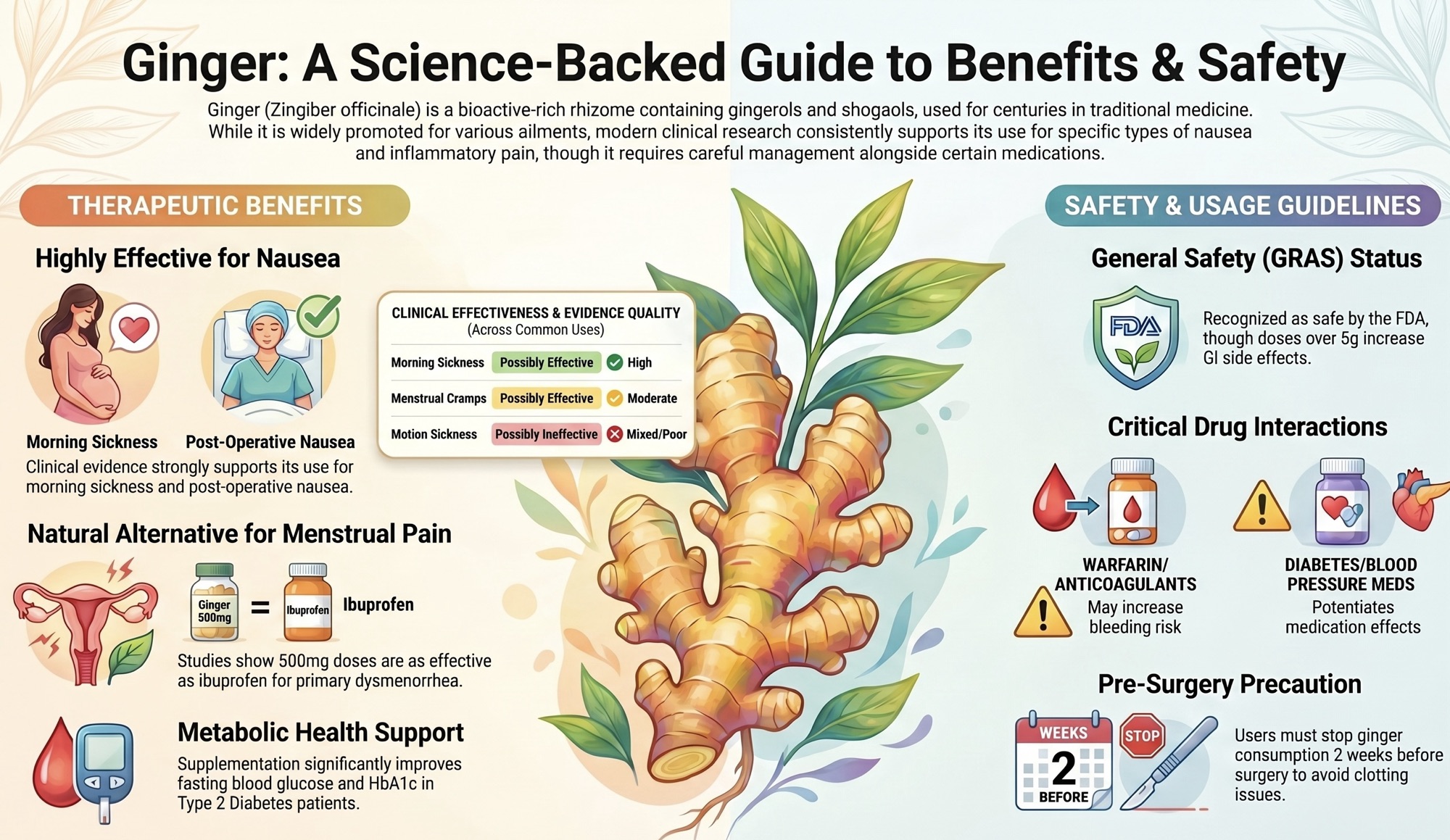
Why has a common kitchen root, a staple of Ayurvedic and Chinese medicine for millennia, suddenly become the subject of over 100 modern randomized clinical trials? The answer lies in the staggering complexity of the rhizome itself. To a clinician, ginger (Zingiber officinale) is not merely a flavor enhancer; it is a “bioactive delivery system,” a pharmacy in a root containing over 400 unique compounds, including pungent oleoresins and volatile oils.
While folk medicine has long prescribed ginger for everything from hangovers to asthma, modern science is finally separating the biological miracles from the myths. We are beginning to see ginger not as a “wellness trend,” but as a calibrated agent for human health.
The following truths, distilled from the latest clinical data, suggest that when used with precision, this humble rhizome can rival standard pharmaceutical interventions in areas of health where we once thought only a prescription could reach.
1. The “Ibuprofen” of the Spice World
For those who suffer through the monthly burden of primary dysmenorrhea (menstrual pain), the search for non-pharmaceutical relief is often met with skepticism. However, the data reveals that ginger is a surprisingly robust anti-inflammatory. It inhibits the synthesis of prostaglandins and leukotrienes—the same biochemical pathways targeted by over-the-counter NSAIDs.
Clinical trials have shown that doses of 250 mg to 500 mg, taken three to four times daily during the first three days of menstruation, are highly effective. In several comparative studies, ginger matched the efficacy of mefenamic acid and ibuprofen in reducing pain scores. Perhaps even more compelling for those struggling with heavy cycles is a randomized trial involving teenage girls, where 250 mg of ginger taken three times daily resulted in a 46.6% reduction in heavy menstrual bleeding.
“Ginger was found to be as effective as mefenamic acid or ibuprofen in women with primary dysmenorrhea.” — Drugs.com Clinical Review
2. The Morning Sickness Gold Standard
Ginger has transitioned from a midwife’s secret to a “Level B” recommendation by the American College of Obstetrics and Gynecologists (ACOG). For expectant mothers navigating the “morning sickness” of the first trimester, the evidence suggests that 1 gram of ginger daily is significantly more effective than a placebo at muting the severity of nausea.
While ginger is celebrated for its safety profile and lack of the drowsiness associated with some anti-emetics, it is important to manage expectations regarding speed. As noted in the meta-analysis data, ginger often presents a slower onset of relief compared to prescription drugs, requiring consistent dosing to reach therapeutic levels.
Nausea Reduction Comparison
Intervention
Nausea Reduction
Vomiting Reduction
Clinical Status & Notes
Ginger (1g/day)
High
Low/Equivocal
ACOG Level B; slower onset than drugs
Vitamin B6
Moderate
Low
Common first-line comparator
Placebo
Low
Low
Baseline
3. The Exercise Myth: Timing is Everything
A common fitness myth suggests that a ginger shot before a workout will dull the burn. However, clinical evidence—including the Black and O’Connor cycling study—confirms that a single 2-gram dose of ginger has no acute effect on muscle pain or perceived exertion during exercise. Ginger is not a “pre-workout painkiller.”
Its true power is found in “chronic” dosing for recovery. Research indicates that taking 4 grams of ginger daily for five days can significantly accelerate the return of muscle strength 24 to 48 hours after high-intensity eccentric exercise. In a nuanced finding from the Matsumura et al. study, ginger-treated groups showed faster strength recovery even while markers of muscle damage, such as creatine kinase, continued to increase. This suggests that ginger assists the body in regaining function and managing the inflammatory response rather than simply masking the initial damage.
4. A Surprising Ally for Type 2 Diabetes
Perhaps the most sophisticated application of ginger lies in metabolic health. For those managing Type 2 diabetes, ginger is emerging as a potent adjunctive therapy. Systematic reviews of high-quality studies have identified significant improvements in fasting blood glucose and insulin sensitivity.
In one notable randomized, double-blind trial of 88 patients, the ginger-treated group experienced a 10.5% decrease in fasting blood glucose, while the placebo group saw their levels rise by 21%. Over 12 weeks, participants also showed significant reductions in HbA1c—a key marker of long-term blood sugar control.
“Pooled data from 8 studies found a significant improvement in fasting blood glucose for ginger compared to controls… with a significant improvement in insulin sensitivity.” — PMC Meta-Analysis
5. Chemistry in the Kitchen: The Heat Factor
The biological potency of ginger is a moving target, dictated by temperature. Fresh ginger is dominated by gingerols, which are excellent for digestive motility. However, when ginger is heated or dried, these gingerols undergo a chemical dehydration into shogaols, which are more pungent and possess more potent anti-inflammatory properties.
This chemistry is best exemplified in traditional preparations like Kashmiri Kehwa, which relies on a specific “Goldilocks Temperature” (80–85°C). This thermal window is critical for a high-potency brew:
- Protecting Crocin: Saffron, a key partner in Kehwa, contains crocin, a carotenoid that suppresses inflammatory cytokines like IL-1β. Crocin degrades if exposed to water above 85°C.
- Activating Shogaols: Maintaining a temperature near 85°C allows the ginger to transition toward shogaol-rich potency while preserving the delicate saffron-ginger synergy that research suggests provides greater relief than either spice alone.
The Critical “Fine Print”: Interactions and Safety
Because ginger is so bioactive, it must be treated with the same respect as a pharmaceutical. While “Generally Recognized as Safe” (GRAS) by the FDA, it has documented interactions with several drug classes.
- Anticoagulants: Ginger may enhance the effects of Warfarin, increasing bleeding risks.
- Blood Pressure: It can increase the absorption of Nifedipine, Losartan, Amlodipine, and other calcium channel blockers, potentially causing hypotension.
- Oncology Interactions: Recent data warns that ginger may increase serum concentrations of Crizotinib, a medication used in cancer treatment.
- The 5g Limit: Exceeding 5 grams daily significantly raises the risk of GI side effects, including heartburn and mouth irritation.
Caution: Surgery Warning Because ginger inhibits platelet aggregation and slows blood clotting, it may cause excessive bleeding during and after medical procedures. You must stop all ginger supplementation at least 2 weeks prior to a scheduled surgery.
Conclusion: The Future of the Rhizome
The clinical data forces us to reconsider our relationship with the ingredients in our pantry. Ginger is not a simple spice to be consumed at random; it is a complex molecular tool that requires calibrated use. Whether matching the efficacy of NSAIDs for pain or supporting glycemic control in diabetes, its success depends on consistent, evidence-based dosing.
As integrative medicine continues to bridge the gap between the lab and the kitchen, we must ask: how many other bioactive agents are currently hiding in plain sight on our spice racks? Reimagining the kitchen as a science-backed extension of the medicine cabinet may be the most important wellness shift you make this year.