




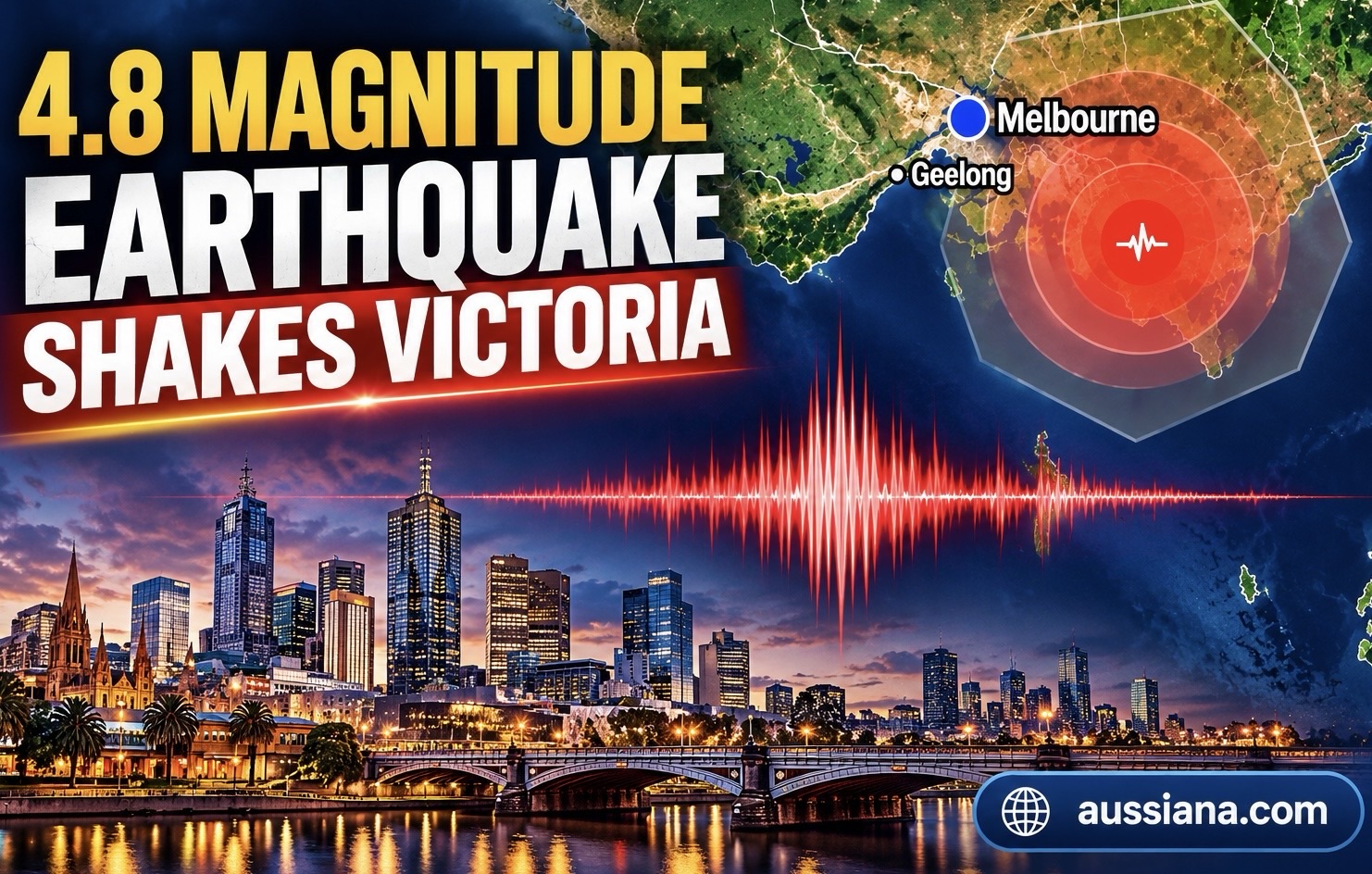
Melbourne, Victoria — October 3, 2026: Thousands of Victorians were jolted awake early Saturday morning after a magnitude 4.8 earthquake struck South Gippsland, with shaking reported across Melbourne and a wide area of regional Victoria.
The earthquake occurred shortly after 2am local time, with Geoscience Australia reporting the epicentre near Leongatha in South Gippsland, approximately 130–135 kilometres south-east of Melbourne. The earthquake occurred at a relatively shallow depth of about 10 kilometres, helping the shaking to be felt over a broad area.
Residents across Melbourne and parts of regional Victoria reported experiencing shaking, rattling windows, moving furniture and beds swaying during the overnight tremor.
The event has once again highlighted an important fact about Australia: although the country is located well away from major tectonic plate boundaries, earthquakes do occur and can sometimes be felt over surprisingly large distances.
Geoscience Australia received thousands of reports from people who felt the earthquake within the first few hours. ABC reported that almost 15,000 felt reports had been submitted by around 3am, while later reports put the number above 16,000 and continuing to rise.
At the time of reporting, there were no confirmed reports of significant injuries or major damage associated with the earthquake.
Where did the 4.8 magnitude earthquake occur?
The earthquake was centred in South Gippsland, near Leongatha and the surrounding area.
Geoscience Australia placed the event near the Leongatha area at a depth of approximately 10 kilometres. The epicentre was roughly 130–135 kilometres south-east of Melbourne.
The location is significant because South Gippsland has experienced earthquake activity in the past. The region is not immune to seismic activity, despite Australia’s general reputation as a relatively stable continent.
The earthquake’s relatively shallow depth meant that seismic energy could produce noticeable shaking at the surface. This helps explain why residents well away from the epicentre, including people in metropolitan Melbourne, reported feeling the event.
Reports were received from areas across Melbourne and regional Victoria. Communities including Geelong, Traralgon, Mansfield and other parts of southeastern Victoria were among locations where shaking was reported.
The actual experience varied considerably from location to location.
Some residents described a short, sharp movement, while others reported a rolling sensation, rattling windows or doors, and beds or houses moving.
Because people experience earthquakes differently depending on their location, building type, ground conditions and distance from the epicentre, descriptions from residents can vary significantly even when they are reporting the same earthquake.
When did the earthquake happen?
The earthquake struck at approximately 2:01am on Saturday, October 3, 2026, according to Geoscience Australia information reported by Australian media.
The timing meant that many Victorians were asleep when the shaking began.
For people living in houses and apartments, the sudden movement was particularly noticeable because there were few other sources of background movement or noise during the early morning.
Several residents reported being awakened by shaking beds, rattling windows and movement within their homes.